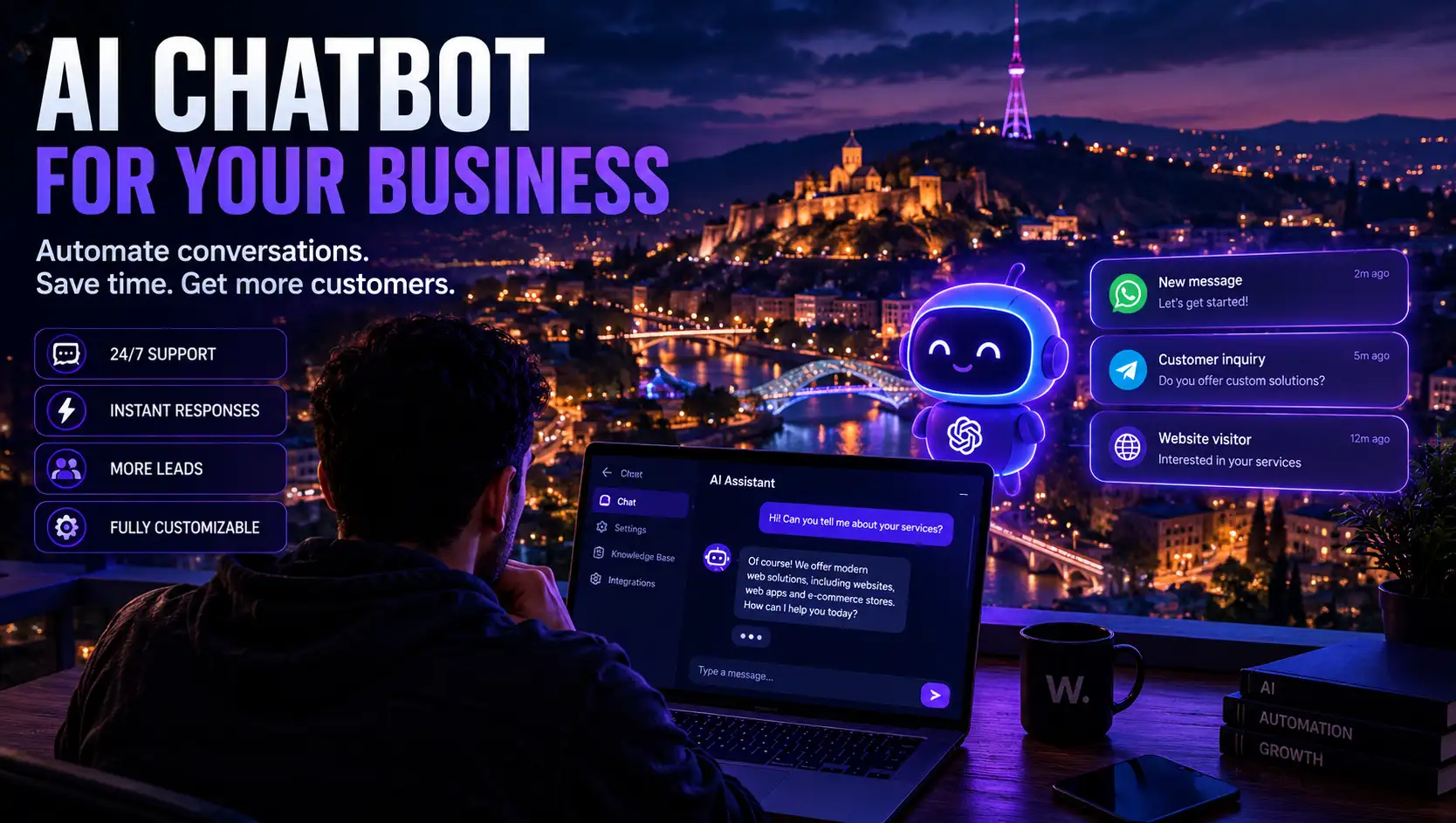
Can AI Chatbots Handle Georgian Customer Support? What Works Now
See where AI chatbots can handle Georgian support today, where they still fail, and how to test, scope, ground, and hand off to humans safely.
You’re answering the same five questions every day. On the website. In Facebook messages. In WhatsApp. “What are your hours?” “How much is delivery?” “Do you have this in stock?” “Can I book for tomorrow?” “Where is my order?” A chatbot sounds like the obvious fix, but you’ve also heard the same thing from everyone in Georgia: AI “doesn’t really speak Georgian”.
The truth is in the middle. Georgian is good enough now for a lot of repetitive support, if you design the bot around the realities of the language, your content, and your channels. It still fails in predictable places. This post is about what works today, what doesn’t, and how to decide without gambling your customer conversations.
1. The honest state of Georgian in AI models — where it's good enough now and where it still shows
Georgian usually works well for short, practical support tasks. It gets shaky when the conversation becomes messy: mixed languages, slang, incomplete sentences, screenshots, or long back-and-forth where the bot has to remember details.
Here’s where Georgian tends to be “good enough”:
- Direct Q&A with clear nouns. Hours, address, delivery areas, return policy, how to pay, how to book.
- Simple intent recognition. “I want to order”, “I need to change my booking”, “I can’t log in”.
- Polite, human-sounding replies. Tone is mostly fine if you keep answers short and structured.
Here’s where the problems still show:
- Case endings and ambiguity. Georgian meaning can shift with small endings. If the bot guesses the wrong subject or object, it can answer confidently and still be wrong.
- Romanized Georgian and mixed scripts. People write “rogor var” or mix Georgian and English product names. A bot might understand the gist but miss the exact product or address detail.
- Regional phrasing and slang. Support messages are rarely textbook Georgian. Expect mistakes with abbreviations, emojis, and voice-message style writing.
- Overconfidence. The biggest issue is not “it doesn’t understand Georgian”. It’s “it answers anyway”. That’s what damages trust.
What to test for (without caring which model you use):
- Messy customer messages. Copy 30 real incoming messages (remove personal data) and test them as-is: typos, short sentences, mixed Georgian/English, Romanized Georgian.
- Follow-up questions. Ask something that requires context: “Okay, and how long does it take to deliver to Vake?” Then: “What if I order after 6?”
- Edge cases. Returns with exceptions, delivery to a non-standard location, “I paid but didn’t get confirmation”.
- “I don’t know” behavior. Ask something that is not on your site. The correct response is not an invented answer. It’s: “I’m not sure. Let me connect you to a person.”
If your test shows the bot often guesses, you don’t “need a better bot”. You need tighter scope, better grounding (section 3), and stricter handoff rules (section 4).
2. What a support bot can realistically handle, and what it should never be asked to do
A good chatbot is not a replacement for your support person. It’s a filter that handles repetitive, low-risk questions instantly and collects clean details when a human is needed.
What it can handle well (realistic use cases)
These are the tasks that usually pay off first because they are frequent and predictable:
- Business basics: working hours, address, parking info, phone numbers, how to reach you, links to your menu/catalog.
- Delivery and pickup rules: areas, time windows, minimum order, same-day cutoffs, pickup instructions.
- Common policy questions: returns, exchanges, warranty basics, cancellations, “what documents do I need”.
- Booking pre-check: available time ranges, what info you need from the customer, confirmation steps.
- Lead capture: “Tell me what you need, your name, and your number” — then hand to a person.
- Order status (only if integrated): if you connect it to your order system, it can answer “where is my order” based on real data. Without integration, it should only explain the tracking process and escalate.
A practical way to define scope is to list your top 20 incoming questions and mark them:
- Can the answer be taken directly from a page/policy you control?
- Is the answer the same every time?
- Is the risk of a wrong answer low?
If yes to all three, it’s a bot task.
What it should never be asked to do
These are the situations where “almost right” is still unacceptable:
- Make promises your team must honor. “Yes, we can deliver in 30 minutes”, “Yes, we can reserve that item”, “Yes, you qualify for a refund.” If it’s not guaranteed by a rule in your system, it must escalate.
- Handle sensitive or legally risky cases. Medical advice, legal advice, disputes, threats, chargebacks, harassment.
- Negotiate. Prices, discounts, special exceptions. If your team sometimes makes exceptions, the bot should route to a person early.
- Interpret photos, screenshots, or long attachments as proof. A customer sends a receipt screenshot or a damaged-item photo. The bot can acknowledge and collect details, but the decision must be human.
- “He said / she said” conflict. If the customer claims something happened, don’t let a bot argue.
A simple rule works: if the conversation affects money, safety, or reputation, the bot’s job is to collect the right details and escalate.
3. Grounding the bot in your own content so it stops inventing answers
Most chatbot failures in Georgian businesses are not language failures. They are content failures.
If your site has vague text, outdated info, or missing policy pages, the bot will fill in the gaps. That’s when you get confident nonsense: wrong delivery zones, wrong pricing ranges, made-up return rules.
“Grounding” means the bot answers from your approved sources, not from its imagination.
What “good grounding” looks like in practice
- One source of truth per topic. One page for delivery. One page for returns. One booking rules page. If you have three different versions across Facebook posts, PDFs, and old site pages, the bot will contradict itself.
- Structured answers. Short bullets beat long paragraphs. Example: delivery zones listed clearly, cutoff time written as a rule, exceptions written plainly.
- Explicit “unknown” areas. If you don’t deliver to certain places, say it. If you do not support weekend pickup, say it. Silence makes the bot guess.
The minimum content set that makes a bot reliable
If you want a support bot that doesn’t invent answers, you usually need at least:
- Contact and location page
- Working hours (including holiday behavior)
- Delivery/pickup policy (zones, time windows, minimum order, fees if applicable)
- Returns/exchange/warranty policy
- Payment methods
- Booking steps (if you take bookings)
- Product/service catalog basics (if customers ask “do you have X?”)
If your website is missing some of these, fix that first. It improves both human support and the bot.
How to force the bot to behave
A reliable bot needs rules like:
- Answer only from your content. If the answer isn’t found, it must say it can’t confirm and offer a handoff.
- Ask a clarifying question instead of guessing. If a message contains two products, or no location, the bot should ask: “Which product do you mean?” “Which district are you in?”
- Keep answers short. Long answers increase the chance of errors. Support is not an essay contest.
- Show the source when possible. Even a simple “According to our delivery policy…” with a link reduces conflict.
If you’re building this with a vendor, ask them exactly how the bot is prevented from answering outside your content. If the answer is vague, you’ll get hallucinations sooner or later.
4. The handoff: when the bot must pass the conversation to a person, and how to make that seamless
A chatbot that can’t hand off smoothly will create more work than it removes. Customers don’t mind talking to a bot if the bot is fast, honest, and can escalate without friction.
When the bot should hand off (clear triggers)
Use hard rules, not “it depends”:
- The customer asks for something not covered by your policies/content.
- The customer repeats themselves or says “you didn’t answer”.
- The message contains anger or urgency: “now”, “ASAP”, “I’m waiting”, “this is unacceptable”.
- The customer asks about order-specific details and you don’t have system integration.
- Anything involving refunds, disputes, cancellations with penalties, or exceptions.
- After two clarifying questions with no resolution.
In Georgian, also consider a language trigger: if the customer switches to English (or Russian) mid-thread, the bot should either follow confidently or escalate. Don’t let it awkwardly answer in the wrong language.
What a “seamless” handoff actually means
It means the human does not start from zero.
At minimum, the bot should pass:
- customer’s question summary (one sentence)
- the answers the bot already gave
- key collected details (name, phone, order number, district, preferred time)
- the channel they came from (website, Facebook, WhatsApp)
If you run a small business, the difference is huge. Without this summary, your staff still has to scroll, interpret, and re-ask. With it, they reply in one message.
Don’t hide your working hours
A bot that escalates at 11pm should not pretend someone will answer. It should say:
- when a person will reply (next working time window)
- what info to leave in the meantime (order number, phone, address)
This alone cuts the “hello???” follow-ups.
Decide who owns the conversation
One common failure: the bot and the human both reply, or neither replies, because the handoff state is unclear.
Set a simple rule:
- When escalated, the bot stops until the human resolves it.
- After resolution, the bot can come back with: “Anything else I can help with?”
If you’re using Weblier for an AI chatbot, this handoff logic is one of the first things we define, because it’s where trust is won or lost.
5. Where it lives — website widget, Facebook, WhatsApp, or all three
Most Georgian businesses don’t have a “support channel”. They have three. Customers pick whatever is easiest for them, and your team ends up repeating the same answers across all of them.
The best choice depends on where your messages already come from.
Website widget
Good for:
- catching questions while the customer is already browsing
- guiding product/category selection
- reducing “I couldn’t find it” messages
- collecting leads with context (“I was looking at X”)
Trade-offs:
- it won’t help with customers who never visit your site
- you must make it fast; a slow widget feels broken
A website bot is usually the cleanest starting point because you control the environment and can link directly to pages.
Facebook messages
Good for:
- businesses that already get most support in Facebook
- quick replies to “how much / where / when” questions
- keeping your page responsive without staff staring at the inbox
Trade-offs:
- people send messy messages, voice notes, and screenshots
- identity and order linking is harder unless you ask for details
A Facebook bot works best when it’s a triage bot: answers basics, collects details, escalates.
Good for:
- direct, high-intent customers (“I’m ready to order”)
- ongoing order/booking conversations
- sending confirmations and instructions
Trade-offs:
- customers treat it like texting a person; tolerance for bot mistakes is lower
- you need very clear handoff and tone
- you must be careful about what data you collect and how you store it
If WhatsApp is your main channel, start with narrow scope: business basics + collecting order details + escalation.
All three (the “single brain” approach)
This is what business owners usually want: one bot behavior across all channels. It can work well, but only if you also unify:
- the knowledge base (one source of truth)
- the escalation process (one place where humans pick up)
- the tone and language rules (Georgian + English, formal vs informal)
Otherwise, you end up with three slightly different bots and three sets of problems.
If you’re choosing a starting point, pick the channel that has the most repetitive questions today. Add the next channel once the first is stable and your team trusts it.
6. What it costs to run once it's live
Running costs are real. They’re also usually predictable if you understand what drives them.
Since pricing structures change often, the useful way to think about cost is: what makes each conversation “expensive”, and what keeps it lean.
The biggest cost drivers
- Message volume. More conversations means more usage. This is obvious, but many businesses underestimate how many “quick questions” they get across channels.
- Long messages and long answers. The longer the conversation, the higher the compute usage. A bot that writes essays costs more than a bot that answers in 2–4 short bullet points.
- Attachments and rich inputs. If customers send images, screenshots, or voice notes and you want the bot to interpret them, complexity goes up fast. Often it’s better to escalate.
- Integrations. Connecting to inventory, booking, CRM, order status, or delivery tracking adds ongoing maintenance. Not every business needs it at the start.
- Monitoring and improvements. The bot needs review. Someone must look at failed conversations and fix content or rules. If nobody owns this, quality degrades quietly.
What a reasonable target looks like
For most small and mid-sized businesses, the first goal isn’t “replace support”. It’s:
- reduce repetitive answers
- shorten response time for basic questions
- reduce after-hours noise
- capture cleaner leads (name, phone, what they want)
That can justify the running cost even if the bot escalates a lot at first.
How to keep running costs under control
- Keep answers short and link to pages. “Here are the delivery zones” plus a link is better than rewriting the whole policy.
- Use fixed options when possible. Simple buttons like “Delivery / Pickup / Return” reduce long free-text conversations.
- Escalate early on complex cases. A 20-message bot conversation that ends with “please wait for a person” is wasted spend and a bad customer experience.
- Update your content instead of patching the bot. If customers keep asking something, make that answer clearer on your site, then the bot becomes cheaper and more accurate.
One more practical point: ownership matters. If your chatbot setup is locked in someone else’s accounts, switching later becomes painful. Weblier’s standard approach is that clients own the code and every account, so you can keep control even if your needs change.
7. Measuring whether it worked: deflection rate, escalations, and customer satisfaction
If you don’t measure, you’ll end up with arguments like “I feel it helped” vs “I feel it annoyed people”. You need a simple scoreboard.
Deflection rate (the core metric)
Deflection rate is: how many conversations were handled without a human.
But measure it honestly. A “handled” conversation is not just “the bot replied”. It’s:
- the customer got an answer and stopped asking, or
- the customer clicked through to the right page and stopped asking, or
- the customer completed a booking/lead form, or
- the customer explicitly said thanks / okay / got it
If customers keep sending “??” after the bot replies, that’s not deflection. That’s noise.
Escalations (and whether they were the right escalations)
Track:
- how many escalations happened
- the top reasons for escalation (delivery exception, refund request, order status, unclear product)
- how many escalations were “avoidable” (the answer existed but the bot didn’t find it)
A healthy bot escalates. The goal is not “zero escalations”. The goal is “escalations for the right reasons, with clean context for the human”.
Customer satisfaction (quick, low-friction)
Don’t overcomplicate this. After a bot-resolved conversation, ask one quick question:
- “Was this helpful?” with a simple yes/no
Then review the “no” conversations weekly. You’ll see patterns fast: one policy is unclear, one product category causes confusion, one channel has different expectations.
A weekly review ritual that actually works
Here’s a simple routine many businesses can keep up with:
- Pick 20 conversations from the week: a mix of successful, escalated, and “bad”.
- Tag each one: good answer / wrong answer / should have escalated earlier / escalated too early.
- Fix the source: update a page, add a missing FAQ, tighten an escalation rule.
- Repeat next week.
Small, consistent fixes beat a big redesign every six months.
FAQ
Will a chatbot embarrass us in Georgian?
It can, if you let it guess. Georgian support works best when the bot is restricted to your approved content, answers in short structured messages, and escalates early when it’s unsure. Before going live, test it with real messy customer messages, not clean sample prompts.
How long does it take to set up properly?
Setup time depends on how ready your content is. If your delivery/returns/booking rules are already clear and consistent on your site, you can move faster. If they’re scattered across old posts and staff “just knows”, you’ll spend time writing down the rules first. That work pays off even without a bot.
Do we have to connect it to our CRM or order system?
Not at the start. A bot can still reduce load by answering business basics and collecting clean details for a human. Integration becomes important when you want the bot to answer account-specific questions like order status or appointment changes based on real data.
Will it replace our support person?
A good bot removes repetitive questions and after-hours noise. It does not replace judgment. You still need a person for exceptions, disputes, and anything that affects money or reputation. The win is that your team spends more time on real cases and less time typing the same paragraph all day.
A chatbot can take a real load off your team in Georgian, but only if you scope it tightly, ground it in your content, and design handoffs like you actually care about the customer experience. If you want to talk it through, we can do a focused 15–20 minute call and decide what’s realistic for your business.