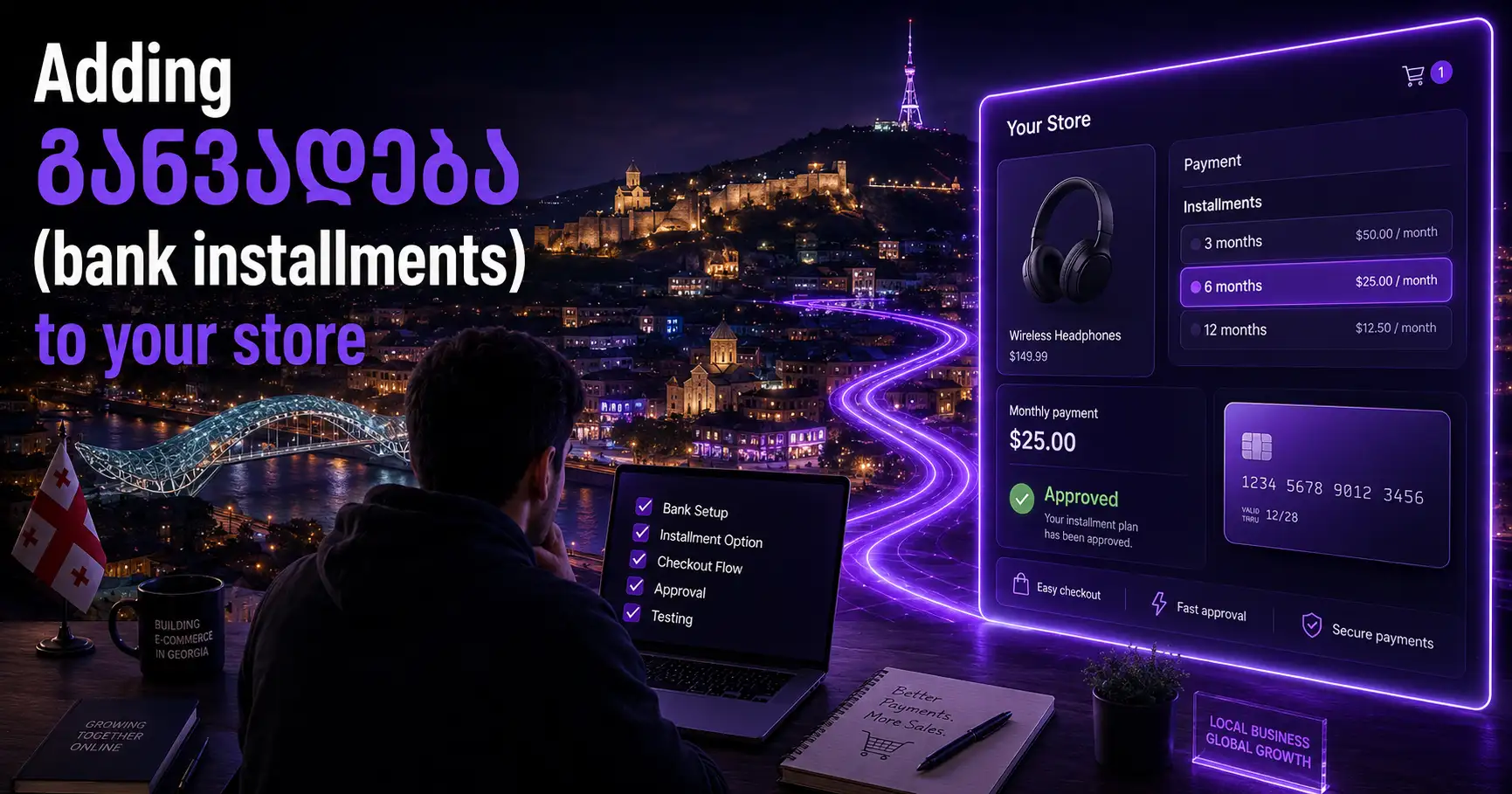
Traffic comes in. People view the product page. They add to cart. Then they see the total and leave. If you sell higher-ticket items in Georgia, that pattern is common—and it’s exactly where bank installments (განვადება) can change your store’s results.
1. Why installments change the math in Georgia — what happens to conversion and average order value
For a customer, a single large payment and a series of smaller payments are not the same decision. Even when the total cost is similar, installments reduce the “pain” of paying all at once. That usually shows up in two store metrics:
Conversion rate (more completed checkouts). The biggest drop-off point for expensive products is the final step: “Do I really want to spend this amount today?” Installments move that question to “Can I handle this monthly?” For many buyers, that’s an easier yes.
Average order value (larger baskets). Once installments are available, customers often stop optimizing for “cheapest acceptable option” and start optimizing for “what I actually want.” In practical terms, that can mean:
- Choosing the higher-spec model (more storage, better screen, larger capacity).
- Adding accessories at checkout (extended warranty, installation, matching items).
- Buying the full set now (e.g., sofa + armchair, or washer + dryer).
There’s also a third effect that matters in Georgia: trust. If customers see a familiar bank installment option at checkout, it can reduce anxiety about buying from a store they haven’t used before. It’s not a replacement for reviews, policies, and clear contact info—but it helps.
The trade-off is simple: installments don’t magically create demand. They mostly help when demand already exists, but the upfront payment is the obstacle. If your product is an impulse purchase, the “monthly” framing can even slow the buyer down because it makes them think harder.
A quick self-check: look at your analytics and answer these two questions.
- Do people reach checkout and abandon when they see delivery + total?
- Do you get messages like “Can I pay in installments?” or “Do you have ganvadeba?”
If yes, installments are worth testing.
2. Who offers installments and how the options differ for a merchant
In Georgia, installment programs are typically offered through banks and sometimes via payment providers that connect to bank programs. As a merchant, you’ll usually encounter installments in one of these shapes:
Bank program (direct agreement)
You sign a merchant agreement with a bank. Your store offers that bank’s installment option at checkout.
What to compare:
- How the installment is initiated: fully online during checkout vs requiring a follow-up step.
- Customer flow: does the customer authenticate with their bank credentials, or is it handled another way?
- Settlement model: how and when the merchant receives funds (confirm current terms with the bank).
- Operational tooling: a merchant portal for tracking installment orders, cancellations, and reconciliations.
- Support model: who handles customer questions when approval fails or documents are requested.
Payment gateway / PSP route
Some merchants prefer going through a payment provider that supports installments (or multiple banks) behind one technical integration.
What to compare:
- Which banks are actually supported for installments (not just card payments).
- How “one integration” it really is: do you still need separate bank contracts, or does the provider handle part of that?
- Refund and cancellation handling: whether it’s done inside one dashboard or fragmented across systems.
- Fees and terms: you still need to confirm current commercial terms; the structure can differ from direct bank agreements.
Links, QR flows, and “pay by application” workarounds
You’ll sometimes see merchants handle installments outside checkout by sending a payment link or guiding the customer to a bank application process after placing the order.
This can work for manual sales, but it has clear downsides for an online store:
- More steps means fewer completed purchases.
- More support time for your team.
- Harder analytics: the abandonment happens “off-site,” so you can’t easily measure where customers drop.
If you want installments to fix cart abandonment, you usually want installments inside checkout, not as a separate after-order process.
3. What it costs you: the commission model, and whether to absorb it or price it in
Installments are not free for the merchant. The most common structure is a commission/merchant fee model. The exact rate, rules, and what it applies to depend on the bank and your contract, so you should confirm current terms directly with the bank.
What matters for your decision is not the exact percentage. It’s the business logic of how you handle that cost.
Option A: You absorb the commission
You keep the same shelf price for all payment methods and treat the installment commission as a cost of acquiring the order.
This is usually the cleanest customer experience:
- One price everywhere.
- No “installment price” confusion.
- No awkward conversations at pickup/delivery.
When it makes sense:
- Your margin can handle it.
- Your conversion lift is strong enough that the extra orders cover the cost.
- Your competitors already offer installments without price differences.
Risk:
- You can end up “subsidizing” customers who would have paid by card or cash anyway, if your checkout pushes too hard toward installments. The way you present payment methods matters.
Option B: You price it into the product
You set your prices knowing that a portion of sales will come through installments and will cost more to process.
This is common in practice because it’s simple operationally. But you need to be careful:
- If your prices become uncompetitive, you lose non-installment buyers.
- If your market is price-sensitive and customers compare product pages across stores, even a small difference can matter.
A middle path is: keep base prices competitive and use installments mainly for higher-ticket items where the “monthly” framing matters most.
Option C: Different pricing for installments (use with caution)
Some merchants want to add a visible “installment surcharge” or offer a cash discount. Whether you can do this depends on your agreements and local compliance expectations, so confirm what’s allowed.
Even if allowed, it can create friction:
- Customers feel “punished” for using installments.
- Your support team spends time explaining pricing.
- Returns become more sensitive because customers will ask what happens to the extra amount.
If you go this route, your checkout messaging and policies must be crystal clear.
The practical takeaway
Before you sign anything, build a simple model:
- Estimate what share of orders will use installments.
- Estimate how many additional orders you expect because installments exist.
- Decide your pricing strategy up front so you don’t change prices mid-season and confuse returning customers.
4. The customer's experience at checkout — where approval happens and how long it takes
From the customer’s perspective, installments should feel like just another payment method. The best flows are predictable and fast. The bad flows feel like “I clicked pay and disappeared into a bank app and now I’m not sure if the order is placed.”
Most installment checkouts include these stages:
1) Customer chooses installments as the payment method
At this moment, your store should answer basic questions without forcing the customer to call:
- Which bank(s) are available.
- Whether the customer must be a client of that bank.
- What happens after approval (do they return to the store and see a confirmation page?).
2) Identity and eligibility check (handled by the bank)
Approval is bank-side. The bank decides whether the customer is eligible based on their internal rules. As a merchant you generally do not see the reasons for rejection, and you shouldn’t try to “solve” it inside your store.
What you can do:
- Make it easy to switch to another payment method without losing the cart.
- Provide a clear message: “If your installment request is declined, you can pay by card or choose another bank.”
3) Confirmation back to your store
This is the most important technical and UX point: your store must know whether the payment is approved, declined, or pending.
A clean flow ends with:
- An order confirmation page.
- An email/SMS confirmation.
- A visible order number.
If the flow ends in uncertainty (“I think it went through”), you’ll see:
- Duplicate orders.
- Angry customer messages.
- Extra work for your team reconciling what happened.
4) Time-to-approval: what to expect without guessing numbers
Different banks and programs behave differently. Some decisions can happen immediately during checkout; others can require additional verification steps or manual review. Your job is to design for both outcomes:
- If approval is immediate: keep the customer in a tight flow, and return them to your confirmation page.
- If approval can be delayed: tell the customer clearly that the order is pending until approval, and what you will do next (hold stock, call them, or cancel after a period—based on your policy).
This is also where merchants get caught: stock reservation. If you sell limited inventory, decide whether installment orders reserve stock immediately or only after approval. Either choice is fine, but you need one rule and you need to communicate it.
5. What it takes to add to an existing store technically
You don’t need to think like a developer, but you do need to understand what changes in your store operations when installments are introduced.
Adding installments is usually not “just a logo in the footer.” It touches checkout logic, order statuses, and refunds.
What you typically need on the store side
- A checkout payment method integration that sends the order amount and order reference to the bank/payment provider and receives a success/decline result.
- A return/redirect flow so the customer ends up back on your store confirmation page.
- Order status handling for cases like approved, declined, pending, canceled.
- Admin visibility so your team can see how the customer paid and what to do next.
What you’ll need from the bank/provider
Expect to provide:
- Your legal entity details.
- Settlement account details.
- Store URLs and technical contact info.
- A list of your domains (especially if you run multiple storefronts or languages).
You’ll also want to confirm with the bank:
- Whether you can run a test environment before going live.
- What “success” and “failure” look like from the store’s perspective.
- How cancellations and refunds must be sent (and whether partial refunds are supported).
Platform reality: plug-in vs custom work
Whether this is simple or complex depends on what your store is built on and how customized your checkout is.
- If you use a mainstream platform with a supported integration for your chosen bank/provider, it can be straightforward.
- If your checkout is customized, multi-currency, or tightly tied to your inventory and delivery logic, you’ll want careful implementation and testing.
At Weblier, this is the kind of work we plan as part of the store’s checkout and operations, not as a last-minute add-on. We build bilingual (Georgian + English) stores as standard, so installment labels, error messages, and policy text are consistent in both languages.
Testing you should insist on (because it prevents real-world headaches)
Before launch, make sure you can test:
- Approved flow end-to-end (customer returns to confirmation page, order is marked paid/approved).
- Declined flow (customer can retry or choose another method without losing cart).
- Interrupted flow (customer closes the bank window/app and comes back later).
- Duplicate submission (customer clicks back/refresh).
If your team has to “guess” whether an installment order is real, you’ll pay for it in support time.
6. Returns, cancellations, and partial refunds — the part that catches merchants off guard
Installments change returns. Not because returns become impossible, but because the process involves three parties: you, the bank/provider, and the customer.
This is the section to read twice, because it’s where merchants get surprised after the first serious return.
Cancellation before shipping
If an installment order is approved and you cancel it before shipping, you need to know:
- Whether you must send a formal cancellation through the bank/provider system, or if canceling the order in your store is enough.
- Whether the customer gets an immediate reversal or a bank-side timeline applies (confirm current terms with the bank).
Operationally, you should define:
- Who in your team is allowed to cancel installment orders.
- What “proof” you keep (customer email, call log) in case of disputes.
Full returns after delivery
The customer returns the item. You approve the return. Now what?
With a normal card payment, you refund to the same card and you’re done. With installments, you must ensure the bank/provider receives the correct refund instruction tied to that installment plan.
Two practical points:
- Your return policy must say that refunds for installment purchases are processed back through the installment provider/bank, not as cash.
- Your team needs a checklist so they don’t accidentally refund via one channel while the bank still expects another.
Partial refunds are where complexity spikes
Partial refunds happen when:
- The customer returns one item from a bundle.
- You compensate for a defect without taking the item back.
- Delivery/installation is refunded but the product is kept.
Not every installment setup handles partial refunds the same way. Some support it cleanly; others require canceling and recreating something on the bank side; others may require a different approach.
You do not want to discover this after you’ve promised the customer “We’ll refund the difference today.” So confirm in advance:
- Whether partial refunds are supported.
- How they affect the customer’s installment schedule (the bank decides the schedule mechanics).
- What your store should show as the refunded amount and payment state.
Exchanges: treat them as a policy decision, not an improvisation
Customers will ask for an exchange (“same product, different color” or “upgrade model and pay the difference”). With installments, exchanges can be:
- Simple (if you treat it as return + new purchase).
- Messy (if you try to “edit” the original installment order).
Decide your rule:
- Either you allow exchanges only through cancel-and-rebuy, or
- You define a controlled process for upgrades/downgrades.
What matters is consistency, because consistency reduces disputes.
Disputes and chargebacks are different from “bank installment issues”
Installments can reduce typical card fraud pressure because the bank verifies the customer. But disputes can still happen:
- “I didn’t receive it.”
- “It’s not as described.”
- “You canceled but I’m still being charged.”
You need clean evidence:
- Delivery confirmation.
- Return acceptance documents.
- A record that the bank/provider refund was initiated.
Installments don’t replace good order documentation. They demand it.
7. Should you offer it? The kinds of stores where it pays off, and where it doesn't
Installments are powerful when they match your product and your customer’s decision process. They are not automatic profit.
Installments tend to pay off when:
You sell high-ticket items with clear specs. Electronics, appliances, tools, furniture, equipment—products where the buyer already knows what they want and the barrier is the one-time total.
Your customers compare options and delay purchase. If people revisit the same product multiple times, installments can be the final push.
You have strong logistics and clear policies. When you deliver on time, communicate well, and handle returns cleanly, installments amplify your strengths. When operations are messy, installments amplify complaints.
You have upsells that make sense. For example:
- Installation and setup.
- Extended warranty.
- Accessories that are genuinely useful.
Installments can lift the full basket, not just the main item.
Installments may not be worth it when:
Your average order is already low. If customers buy small items, the commission cost and operational complexity can outweigh the conversion gain.
Your margins are tight and prices are heavily compared. If your market is a race to the lowest price, you may not have room to absorb the cost, and pricing it in may lose sales.
Your return rate is high. If you sell categories with frequent returns, installments add extra steps and more customer questions. You can still do it, but plan the workflow first.
You don’t control stock availability. If you rely on suppliers with uncertain stock, installment “pending/approved” states can create more cancellations and customer frustration.
A simple decision framework
- Measure your current problem. Where exactly are customers dropping? Product page, cart, shipping step, or payment step?
- Estimate upside honestly. Installments help most when price is the main blocker.
- Confirm terms and operational rules. Don’t sign first and figure out refunds later.
- Launch with tracking. Tag installment orders in your reports. Compare conversion, AOV, cancellation rate, and return rate for installment vs non-installment orders.
If you do it, do it cleanly. A confusing installment checkout can lose the same customers you’re trying to save.
FAQ
Do I need to show an installment calculator on product pages?
It helps, especially for expensive items, because it reframes the price before the customer reaches checkout. But only show information you can keep accurate. Terms can change by bank and by customer eligibility, so avoid promising exact monthly amounts unless your bank/provider explicitly supports a reliable calculator feed.
What if the customer is declined—will I lose the sale?
You might, unless you design for it. The key is to let the customer switch to another payment method without starting over. In practice that means: don’t break the cart, don’t lose shipping details, and show a clear message about next steps.
Can I offer installments on only some products?
Usually yes, but it depends on your agreement and how your integration is set up. Many merchants start with high-ticket categories first (where the uplift is most likely) and expand after they see results. Confirm any product/category restrictions directly with the bank.
Do installment orders count as “paid” immediately in my store?
That depends on the approval and confirmation flow. Some setups provide a clear approved result during checkout; others can be pending. Your store should reflect reality with proper statuses so you don’t ship unpaid orders or accidentally cancel approved ones. Confirm the exact flow with your bank/provider before launch.
If you want to add installments without breaking your checkout or creating refund headaches, a short scoping call is usually enough to map the right approach. We can review your current store, your products, and the flow you want, and tell you what’s involved.