Coldfire CRM
The AI-native cold-calling platform built around one rule — you call, Coldfire documents it, workflows handle the rest.
Visit coldfire-crm.com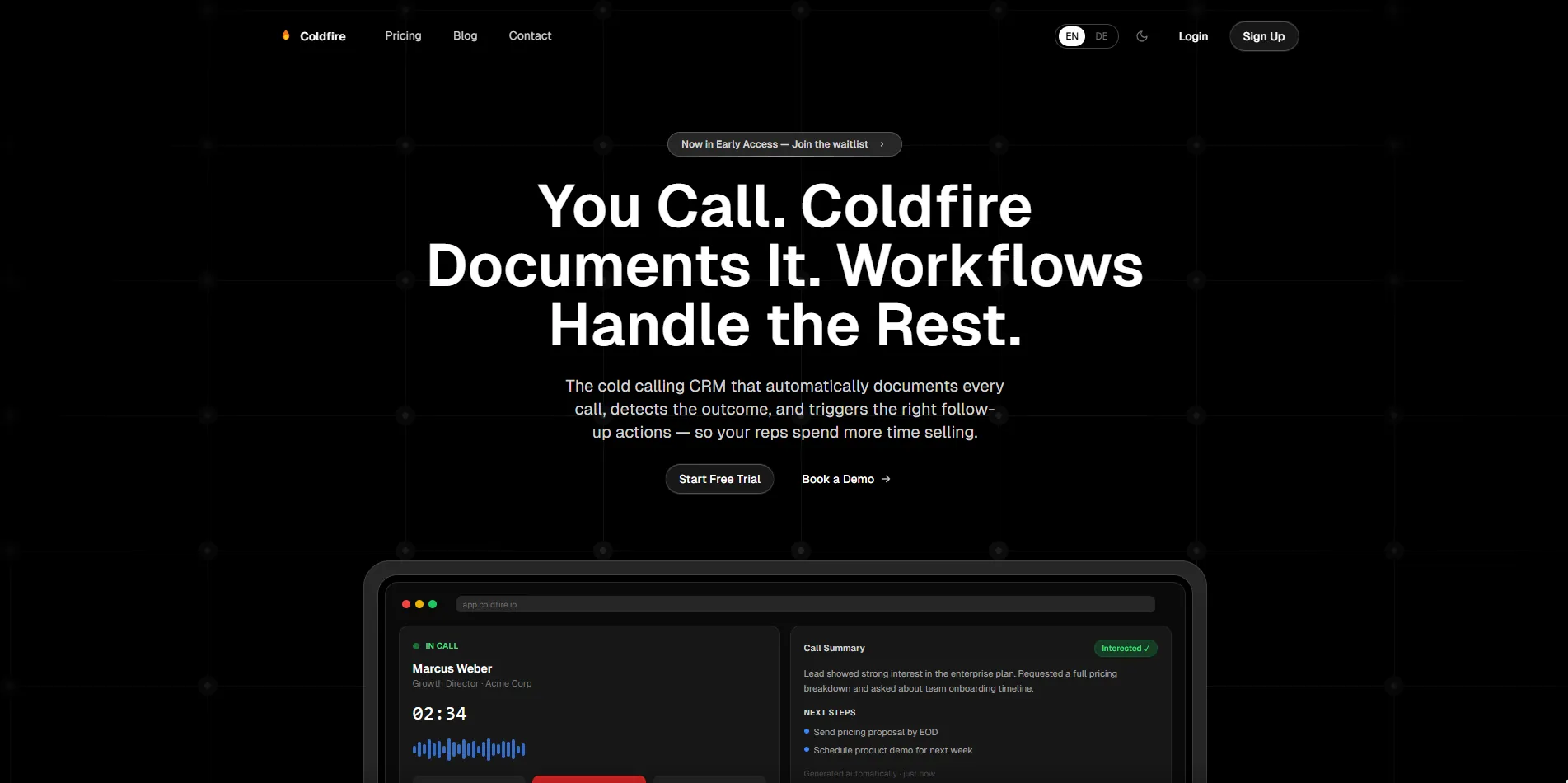
Sales reps hate admin. After a call they should be thinking about the next one — not typing up notes, updating pipeline stages, or scheduling follow-ups. That loop kills momentum, and it's the single biggest reason outbound teams under-perform.
Coldfire was built to end it. A browser-based VoIP stack calls the lead, an AI model transcribes and summarises the conversation in real time, and an outcome-aware workflow engine fires the right follow-up automatically — move the deal to negotiation, send the pricing email, book the demo on the rep's calendar. All of it, without a single keystroke.
This was a full ground-up product build: sub-second live transcription, outcome-based automations, mid-call phone scripts, intelligent lead discovery from Google Maps and CSV imports, team dashboards with live leaderboards, granular role management, and deep integrations with the tools sales teams already live in — Twilio, HubSpot, Slack, Google Calendar. A CRM that quietly does the admin your team was about to do, before they realise it needs doing.
Under the hood sits Coldfire Backend — a production-grade platform engineered to stay fast while call volume scales. A hardened Strapi core drives the content and configuration APIs. Postgres handles the relational heavy lifting with carefully tuned indexes, versioned migrations, and query plans reviewed against real traffic. The auth boundary is written once and reused everywhere — one identity layer, one session primitive, every route through the same guard. Anything that touches a live call runs in-process and fast; everything that doesn't — outbound emails, CRM syncs, analytics, exports — gets pushed onto a queue, so P99 latency stays flat even under load. Services are packaged into Docker images and rolled out to a Kubernetes cluster with autoscaling, rolling updates, feature flags, and zero-downtime releases. Observability, secrets management, CI/CD pipelines and SOC-friendly access controls are wired in from day one — so the product stays boringly reliable while everything on the surface keeps shipping fast.